The Ferguson Law and the US’ Fight for a Small Government |
| | This email is intended for the addressee. Please do not forward this note outside your institution. Thank you for your cooperation. |
| www.eurizonsljcapital.com |
| | | | | May 13, 2025
Stephen Jen and Joana Freire |
| | Summary: The Trump Administration has been fighting to alter the trajectories of the US’ twin deficits. While the tactics and execution have been somewhat clumsy, their goals are justified. Of the two deficits, we think the fiscal deficit is both more urgent and more important to address. As intense pressure on the trade war is vented and negotiations are executed more methodically, we suspect investor attention could shift to the budget bill and the fiscal trajectory of the US. The long-term US Treasury yields having been stubbornly elevated suggests that investors no longer believe in the US’ ability to bend the fiscal deficit curve. We share this concern. Back in November 2024, we issued a note arguing that the Trump Administration was determined to pursue a small government agenda and would be successful in making meaningful progress in diffusing this time bomb. We confess that we are losing confidence. The market consequences are, of course, no good. Expenditure cuts are key. |
| | The Ferguson Law
Over a decade ago, historian Niall Ferguson pointed out the importance of the relationship between interest payments and defence spending: any great power that spends more on interest payments than on defence has reached a ‘tipping point’ and is set to decline as a global power, so Sir Ferguson argued. Large debt burdens eventually act as a force draining national resources, reducing funds available for infrastructure, defence, technology and other investments critical to sustaining global leadership. Over time, such countries see their geopolitical standing eroded and become vulnerable to challenges from the rising global forces. Historical examples include the Spanish Empire in the late 16th century, Bourbon France in the late 18th century, Tsarist Russia, the Ottoman Empire in the 19th century1, and most recently the UK in the 20th century2.
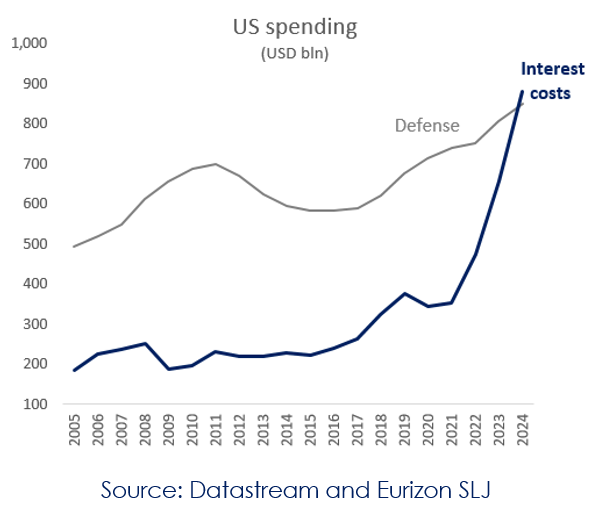
The US ominously reached this tipping point in 2024.
The chart below shows the evolution of US spending on defence and its spending on debt service. |
| | Last year, federal debt servicing reached 3.1 percent of GDP, higher than defence spending for the first time in history. This is double the average cost of debt servicing in the entire post-GFC period. And the expected trend looks bleak: the CBO expects this gap to widen significantly, reaching 4.1 percent of GDP by 2035, even eclipsing the burgeoning costs of Medicare. As the US population ages, mandatory spending, including health and social security, should continue to surge. The Social Security Trust Fund is thought to be only eight years from insolvency. Meanwhile, the CBO expects defence spending to fall from 3.0 to 2.4 percent. The current government has announced its intention to boost the defence budget above USD1 trillion, but the pressures on funding the debt are clearly building.
The US has clearly breached the Ferguson threshold.
The case for fiscal consolidation
In a note we issued last year (‘Small Government and Spending Cuts under Trump 2.0,’ November 13, 2024), we pointed out some parallels between Trump 2.0 and Reagan’s first term in 1981, that the Trump Administration would pursue a small government fiscal posture. The first ‘3’ of Secretary Bessent’s 3-3-3 policy was a fiscal deficit in the 3-percent of GDP range. DOGE was announced on November 12, 2024, a mere week after the election victory. And in the first weeks of the Trump Administration, both President Trump and Secretary Bessent seemed to have paid more attention to the bond yields than the performance of the equity markets, in stark contrast to the prior years. All of the above point to an Administration that has been very focused and determined to address the issue of the runaway fiscal deficit.
Secretary Bessent has also argued that the US has a spending problem, not a revenue problem, by citing that the long-term average revenues-to-GDP ratio has been around 17 percent over the past seven decades, while spending has exploded from its long-term range and reached some 23-24 percent of GDP in recent years.
The US’ public debt is around 100 percent of GDP, and could in a short ten years time, reach 120 percent of GDP, which was the level of debt Italy had during the European Debt Crisis.
The case for a dramatic fiscal consolidation is clear to most, and we were convinced back in November 2024 that the Trump Administration understood the urgent need to arrest the runaway fiscal trend.
But the early signs point to a gap between pronounced intent and reality.
Notwithstanding our positive view on the Trump Administration’s intention to address the fiscal deficit problem, recent developments don’t give us confidence. Thus far, unfortunately, the prospect of broader spending cuts to bring down the debt and cap debt servicing has been elusive. There appears to be little urgency in the White House or the Republican-led Congress to address the bloat in federal spending. The efforts and the rhetoric have been geared towards a ‘pro-growth’ budget, with a clear emphasis on tax cuts and how they could lead to a supply-side boost.
The political mathematics of tax cuts is straightforward; the political calculus for spending cuts is a lot more challenging, given the vested interests related to government funding. Many government institutions and departments directly benefit the constituents of congressional leaders. This is probably why the rescissions package, which was supposed to be submitted by the WH for a vote in Congress in early May, was pushed back. This vote would’ve crystalised into law many of the reductions in spending proposed by DOGE.
The US’ federal budget is around USD7 trillion, and its revenues are USD5 trillion. The fiscal deficit of USD2 trillion needs to be compressed. We think USD500 billion could (eventually) come from DOGE, and import tariffs could raise another USD300 billion. But this would still leave USD1.2 trillion to be filled. New tax cuts would, of course, push the goalposts further away.
Our thoughts
We have a few thoughts.
1. The (r-g) gap. One key variable to containing long-term debt is ensuring that debt service grows slower than the economy. This is essentially the requirement that the long-term real economic growth (g) needs to exceed the real interest rate (r), i.e., the (r-g) gap should be negative. Productivity growth cuts in entitlement spending and central bank monetisation of debt could, under the right conditions, all help to keep (r-g) negative. From this perspective, the US’ muscular efforts at elevating the value-add of US manufacturing and services and technological advancements should be helpful. Tax cuts should be aimed at encouraging growth in these areas and not consumption. Also, if reshoring is successful, we will, at some point, see an increase in the US tax base through both higher production in the US and through additional labour and income taxes. However, all of these reforms that boost ‘g’ cannot be easily measured and will only bear fruit over a longer-term horizon.
2. The fiscal deficit widened during Reagan 1.0, despite President Reagan’s intent otherwise. Even though the Reagan Administration also declared their intent to pursue a small government fiscal posture, in actuality, federal government spending did not change: 22 percent of GDP in 1981 (Reagan’s first year) and 1988 (Reagan’s final year in office). It was President Clinton who brought down this figure from 21½ percent to 18 percent, yielding the first federal fiscal surplus in the US in five decades. Reagan failed to compress the fiscal deficit for several reasons, including new tax cuts, higher defence spending, rising entitlement spending due to demographics, modest non-entitlement spending cuts, and finally, the recession and high interest rates proved unhelpful. Come to think of it, there could be many similarities between Trump 2.0 and Reagan 1.0.
3. Recession risks. A technical recession in the US is a possibility. Q1 GDP was negative. With the latest announcement of a temporary US-China ceasefire in the trade war, another period of import binge to evade tariffs could artificially depress US growth for another quarter. However, we do not believe it is likely that the US will see an outright recession, in the traditional sense, this year, mainly because the Fed is not nearly as tight as it was in 1980. Some economic deceleration is likely for reasons readers can imagine. But an outright (non-technical) recession would require more acute policy shocks, in our opinion. Some may wonder about the political implications of a recession early in a Presidential term. In the case of President Reagan, in 1986, the GOP lost seats in the House but retained a majority in the Senate, and of course, Reagan won his re-election in 1984 by the widest margin in Electoral College votes in history.
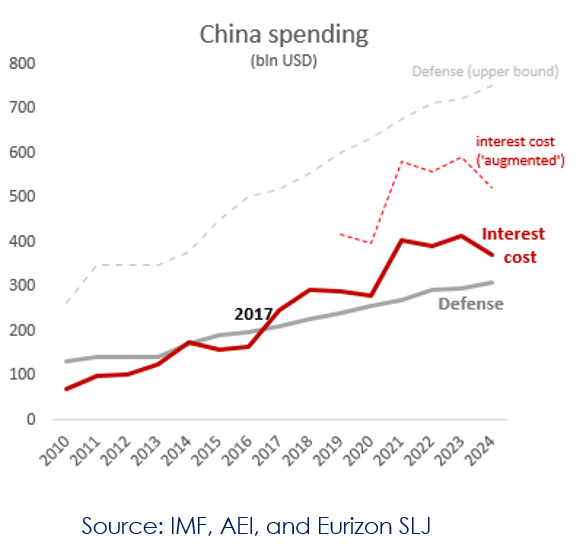
4. China may also be about to breach the Ferguson Law. China’s military spending is high and rising. Some analysts claim it could be as much as USD300-700 billion a year, or 1.5-3.9 percent of China’s GDP; the upper bound of the guesstimates would make it similar to the US’ spending in absolute terms. The wide range of estimates is a function of analysts being unsure about the true size of Beijing’s military spending, given the role that some of the SOEs could play, in addition to direct government spending on weaponry. The IMF computes the consolidated government budget in order to include the local governments' off-budget activities. Using this approach, China's combined government debt is 124 percent of GDP. The chart below shows these estimates, with the bold lines showing the more conservative figures. If China’s defence spending is closer to the lower bound, then China would’ve breached the Ferguson Law as early as 2017. Even if defence spending is much higher than the most conservative estimates, China will likely already have reached that crossover point, especially if we consider the rollover costs of the ‘augmented’ debt, which is the dotted red line. Given that China’s interest rates are unusually low, reflecting its weak demand, we think China will face increasing pressures for funding, just like the US. One lesson here is that, perhaps, both the US and China should focus on getting their houses in order first before telling each other what to do… Just a thought. |
| | 5. R&D spending. In developed countries, government spending on R&D is in the same order of magnitude as their spending on defence, i.e., in the 2.0-3.5 percent range (China’s R&D is about 2.6 percent of GDP, while the US spends around 3.6 percent in R&D). We believe there will be as much of a tech war as there will be a trade war between the US, China, and Europe. This discussion on different goals fighting for fiscal resources should thus also include spending on R&D. High debt service saps the capacity to fund defence as well as R&D.
6. A ‘Truss Moment’? The experience of the UK in 2022 is relevant for thinking about the US budget. That year, Prime Minister Liz Truss announced a fiscal package containing the largest tax cuts in the UK since 1972, worth some 2 percent of GDP. The tax cuts were unfunded and not matched by comparable spending cuts or alternatives to boost revenues. This so-called mini-budget was inspired by Laffer Curve-type models, which assume that such huge tax cuts would boost economic growth to such an extent that it would ultimately pay for itself. The budget was very poorly received by the market. The Gilt market sold off sharply, with long-term borrowing rates jumping over 100bp in just a few days. Ultimately, the BoE had to step in to appease the markets, announcing a purchase programme worth some GBP65 billion worth of gilts, and Ms Truss was forced to resign as Prime Minister. Could the US face a Truss Moment if the tax cuts are unfunded? |
| Bottom line
It is clear to virtually everyone that the US is on an increasingly unsustainable fiscal trajectory. Yet, a commensurate level of political determination to contain spending seems absent. New tax cuts not matched by large spending cuts could yield a worsened fiscal path. We were optimistic in November 2024 about the Trump Administration’s determination and ability to rein in spending, but with so few public comments on the need for spending cuts, we are losing some confidence. The fiscal discussion between now and July 4 will be crucial for the US to avert a ‘Truss moment.’
1In the 1870s, the Ottoman empire’s interest on debt, largely owed to European creditors, consumed over half the budget, exceeding military spending even as the empire was fighting wars (e.g., Russo-Turkish War, 1877–78). Debt service crippled the empire’s ability to maintain military power, hastening its collapse by the early 20th century. 2The UK’s debt after WWI rose from 109% of GDP in 1918 to just under 200% in 1934, when interest payments consumed over twice as much as military spending; but the UK managed to rebalance, thanks to primary surpluses, falling interest rates in the late 1930s and repressed interest rates in the 1950s and 60s. This is a positive historical example for thinking about the position of the US. |
| | Recent Publications
The Ferguson Law and the US’ Fight for a Small Government, May 13, 2025 Another Avalanche Warning on the Asian Currencies, May 6, 2025 US Recession Threshold: 15 percent Import Tariff, April 30, 2025 Made in the USA 2035, April 28, 2025 My Thoughts on Currencies, April 22, 2025 The Risks of Export Dumping by China, April 15, 2025 The Long-Awaited Dollar Correction Finally Commencing, April 7, 2025 My Thoughts on Currencies, March 29, 2025 FX Overlay with Valuation, March 26, 2025 A Strong Core Europe = Higher Centrifugal Force, March 18, 2025 Ukraine Musings: a win-Win-Win Proposal, March 14, 2025 i-Fed, March 5, 2025 My Thoughts on Currencies, March 4, 2025 A Turning Point Metric, March 3, 2025 The Triffin Dilemma and Outward Chinese FDI, February 27, 2025 Make Chinese Equities Investible Again. February 19, 2025 What Happened to Taylor Rules? February 18, 2025 A ‘MAGA SWF’: Don’t Dismiss this Idea, February 11, 2025 External Revenue Service, Tariffs, and a Tobin Tax, February 7, 2025 A Unit of Bitcoin or Double Mag-7? February 5, 2025 My Thoughts on Currencies, February 4, 2025 How the EU has been Hurt by Brexit, January 30, 2025 A ‘Mar-a-Lago Accord’ on September 22, 2025, January 28, 2025 The US’ Net Foreign Liabilities Reached USD25 Trillion, And Are Still Rocketing Higher, January 24, 2025
|
| DISCLAIMER
This communication is issued by Eurizon SLJ Capital Limited (“ESLJ”), a private limited company registered in England (company number: 09775525) having its registered office at 90 Queen Street, London EC4N 1SA, United Kingdom. ESLJ is authorised and regulated by the Financial Conduct Authority (FRN: 736926). This communication is treated as a marketing communication intended for professional investors only and is provided only for information purposes. It has not been prepared in accordance with legal and regulatory requirements designed to promote the independence of investment research and is not subject to any prohibition on dealing ahead of the dissemination of investment research. It does not constitute research on investment matters and should not be construed as containing any recommendation, advice or suggestion, implicit or explicit, with respect to any investment strategy or financial instruments, or the issuers of any financial instruments, or a solicitation, offer or financial promotion relating to any securities or investments. ESLJ and its affiliates do not assume any liability whatsoever for the contents of this communication, save to the extent agreed in any written contract entered into between ESLJ and the recipient, and do not make any representation or warranty as to the accuracy or completeness of any information contained in this communication. Views are accurate as at the time of publication. Opinions expressed by individuals are their own and do not necessarily reflect those of ESLJ or any of its affiliates. The value of any investment may change and an investor may not get back the original amount invested. Past performance is not an indicator of future performance. This communication may not be reproduced, redistributed or copied in whole or in part for any purpose. It may not be distributed in any jurisdiction where its distribution may be restricted by law and persons into whose possession this communication comes should inform themselves about, and observe, any such restrictions. |
| |
|